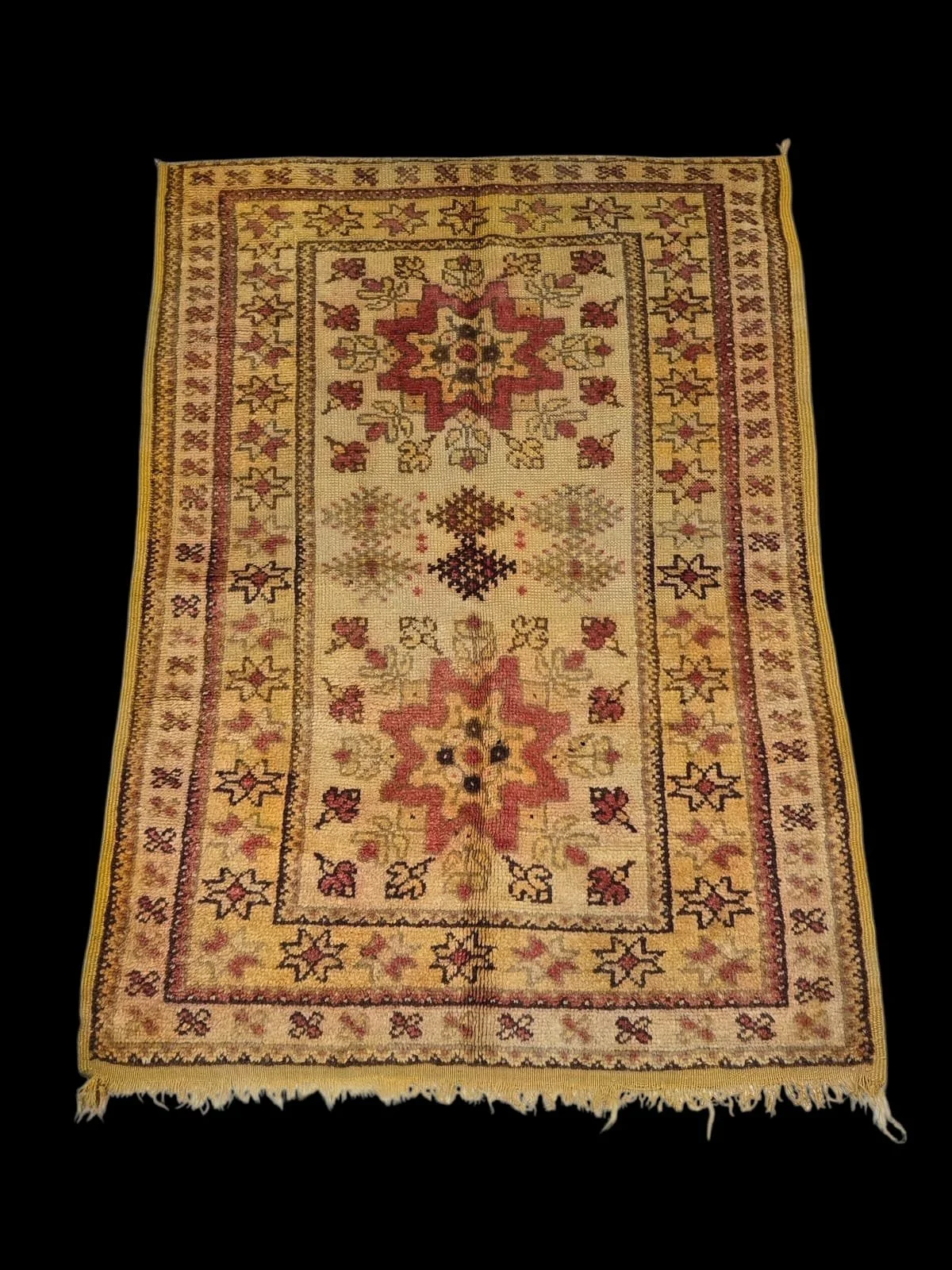
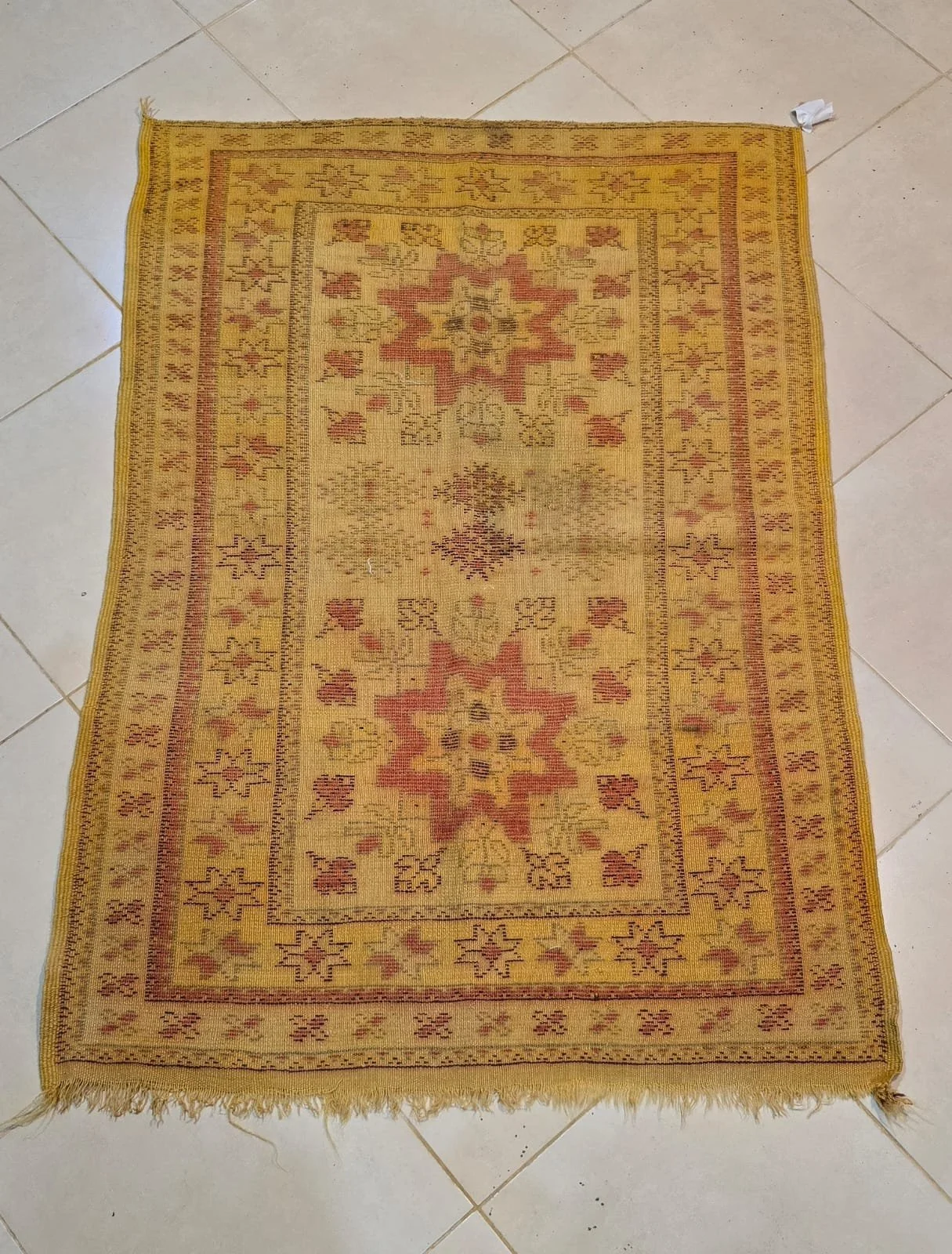
Antique Amazigh Carpet – Golden Moroccan Wool Rug – Symbolic Tribal Art with Rub el Hizb & Protective Motifs – 4.6 x 3.2 ft
This antique Amazigh carpet is a rare and deeply symbolic textile, where history, identity, and craftsmanship converge in a single piece.
Woven entirely by hand using sheep wool and natural dyes, this rug stands apart through its unusually structured composition and layered iconography. Unlike most Moroccan carpets, which favor more fluid or abstract layouts, this piece is built around a clearly defined, repeated central framework, giving it a sense of order, intention, and narrative continuity.
At the heart of the composition is the 8-pointed star, known as the Rub el Hizb, a geometric symbol historically associated with balance, unity, and division of space. Its presence within an Amazigh textile is significant, reflecting cultural intersections and historical layers within Morocco.
Within the central field, six protective shield motifs are arranged to guard against the Evil Eye and misfortune. These are not decorative elements, but active symbolic forms intended to protect the household and its inhabitants.
Two warm red stars anchor the composition, each filled with Amazigh symbols representing the union of male and female. This duality speaks to balance, continuity, and the generational flow of life.
Surrounding these elements are Fleur-de-Lys motifs, referencing a period of French presence in Morocco, and adding another layer of historical dialogue to the piece. The outer borders are defined by strong linear framing, culminating in a field of repeated “X” motifs, understood as the Eye of God—a reminder that all actions are seen and witnessed.
Nothing in this rug is arbitrary. Every symbol is deliberate, forming a visual record of belief, resistance, and cultural identity across time.
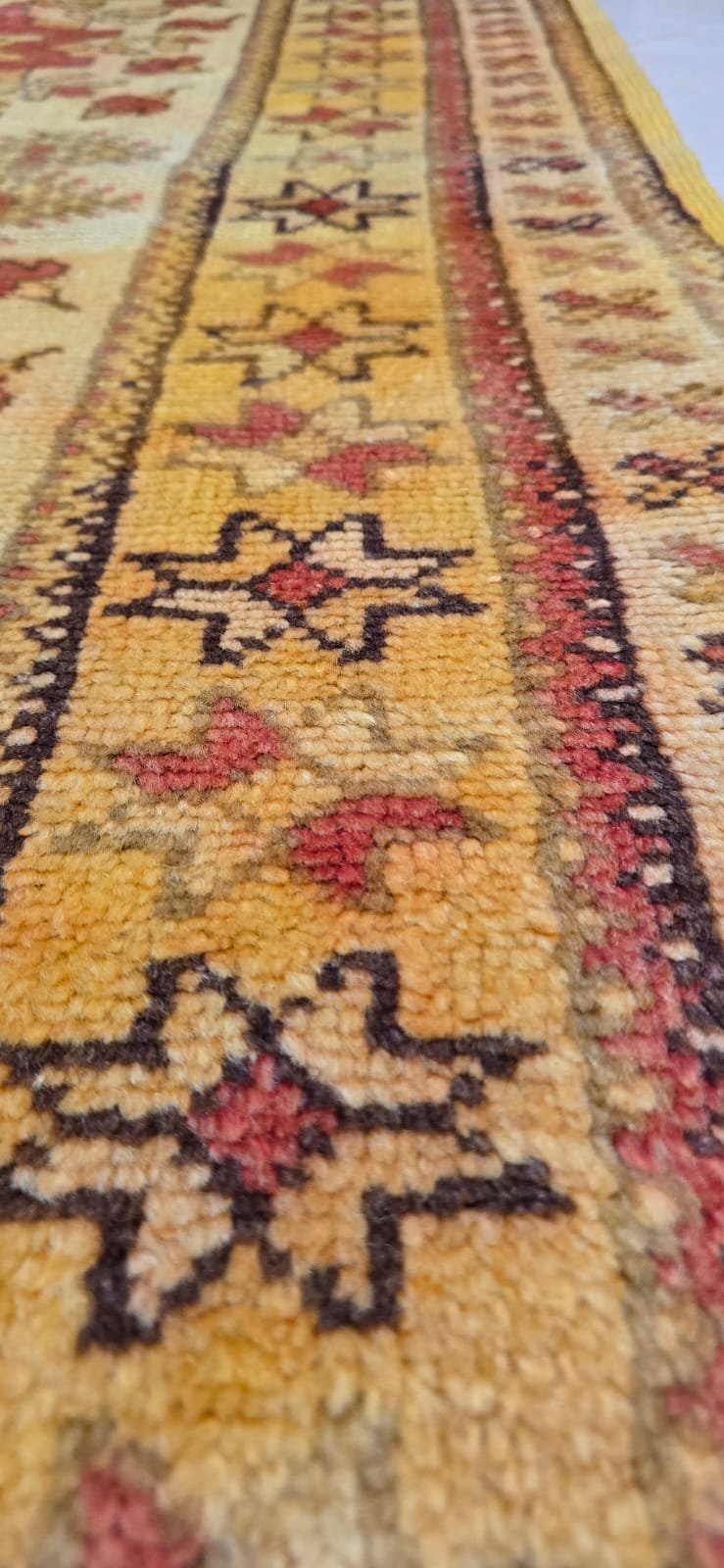
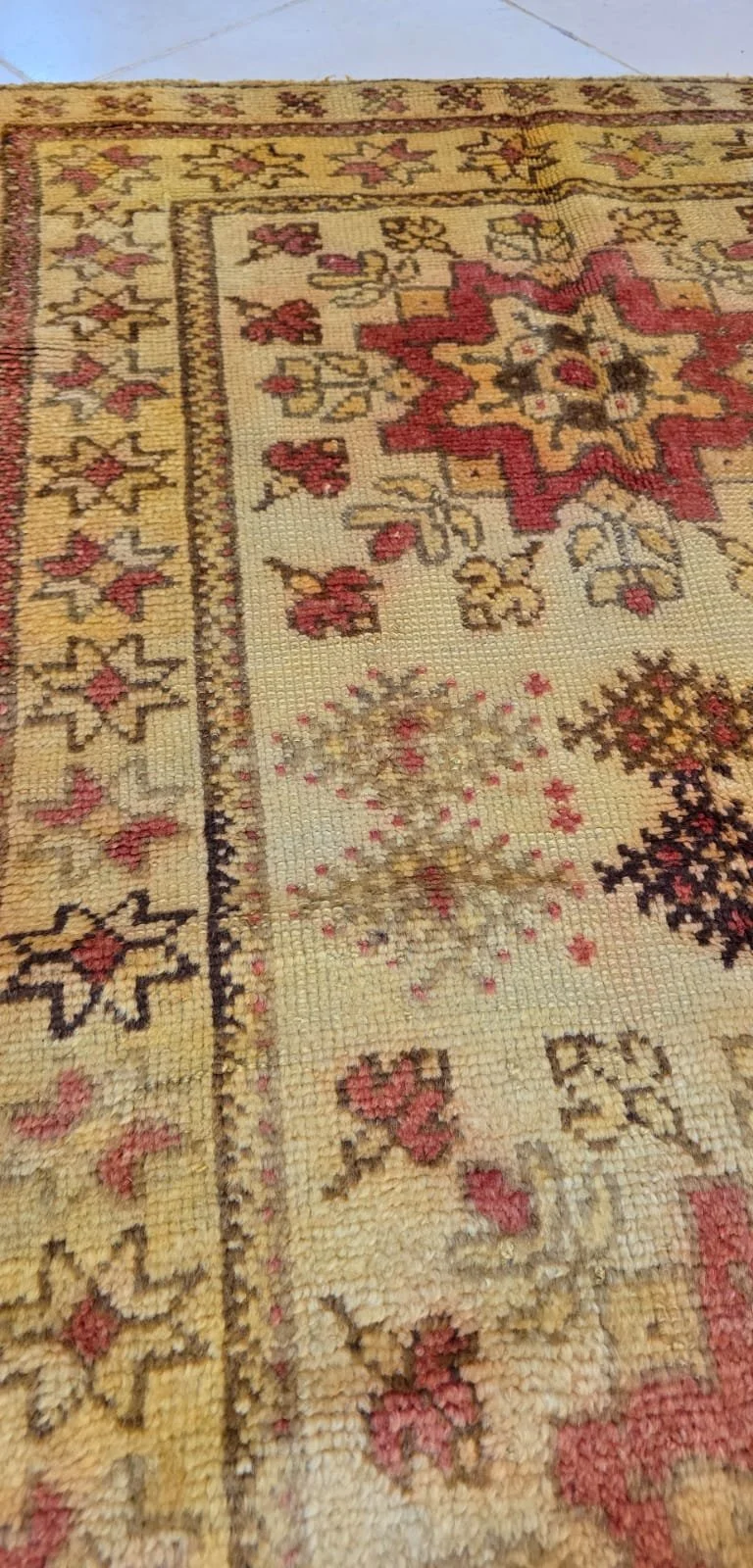
The palette is equally compelling. Golden hues dominate the field, enriched by rose, brown, and muted red tones derived from natural dyes and undyed wool. The surface has developed a soft patina through age, giving the rug depth, warmth, and a quiet luminosity that cannot be replicated.
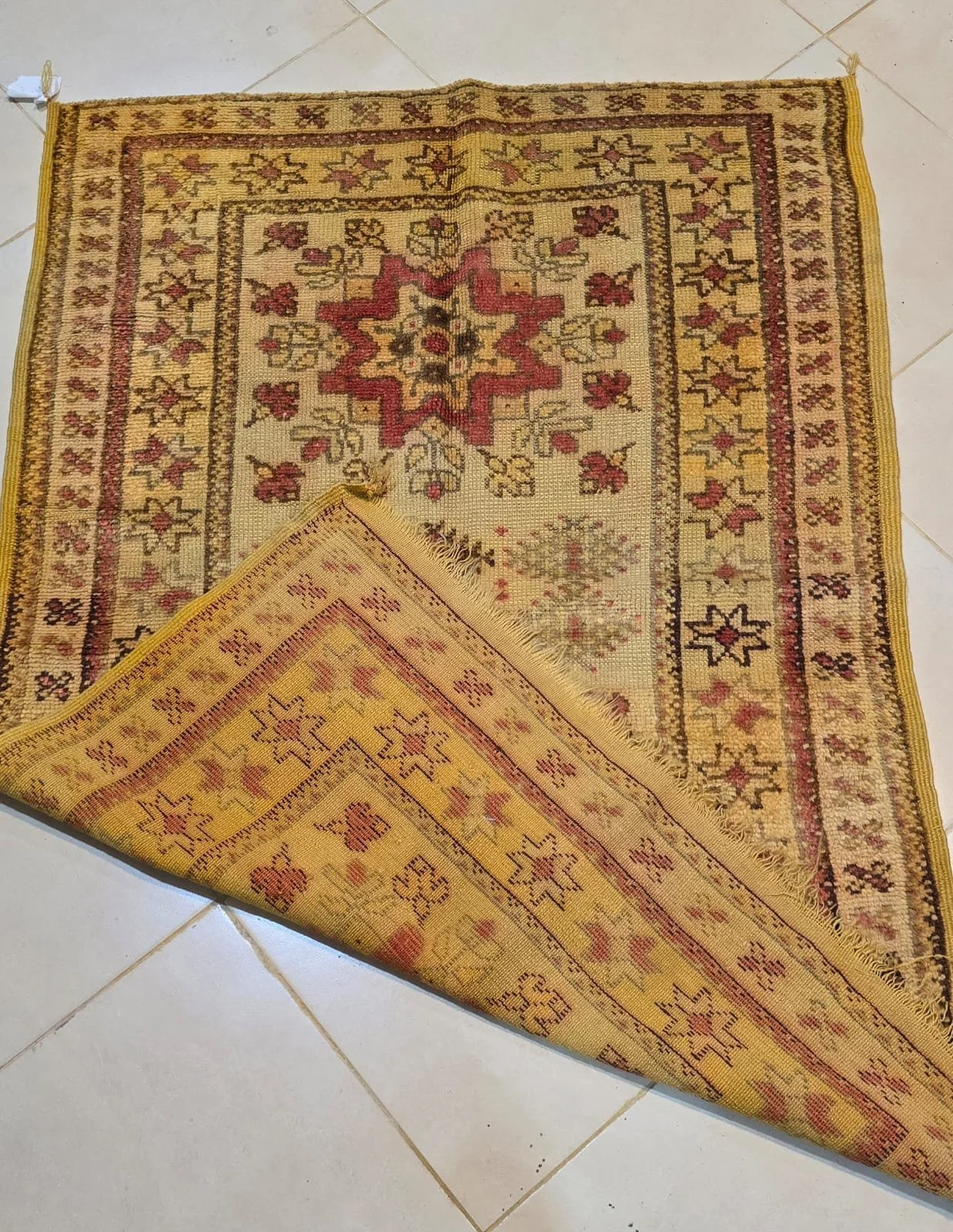
The short, worn pile reflects its age and use, while the wool remains resilient, soft, and structurally sound. This balance between wear and preservation is a hallmark of authentic antique textiles.
This piece is not simply a rug. It is a historical object, a cultural document, and a work of art.
History & Cultural Context:
This carpet reflects multiple layers of Moroccan history, particularly the experience of Amazigh communities navigating cultural and political change.
Amazigh weaving traditions are rooted in personal and tribal expression, where rugs function as both practical objects and symbolic records. Over time, external influences, including Arab expansion and later French colonial presence, introduced new motifs and visual references.
Rather than replacing existing traditions, these influences were absorbed and reinterpreted within Amazigh visual language. This rug is a clear example of that process, where indigenous symbolism coexists with external elements, creating a complex and historically rich composition.
Material & Craftsmanship:
Material: 100% sheep wool
Dyes: Natural dyes and natural wool tones
Construction: Hand knotted
The entire process is handmade:
Wool is sheared, cleaned, and spun by hand
Natural dyes are prepared from local materials
Each knot is tied individually
The rug is finished and aged through use over time
The short, worn pile is consistent with antique use, while the structure remains strong and intact.
Design & Symbolism:
This rug is defined by its layered symbolic composition:
Rub el Hizb (8-pointed star): Balance, structure, unity
Protective shields: Defense against the Evil Eye and misfortune
Male/female union symbols: Fertility, continuity, life balance
Fleur-de-Lys: Historical reference to French presence
Outer “X” motifs: The Eye of God, symbolizing awareness and protection
Together, these elements create a dense symbolic field that is both protective and narrative in nature.
Details:
Region: Morocco (Amazigh / Berber)
Style: Antique symbolic tribal carpet
Material: 100% sheep wool
Dyes: Natural dyes
Construction: Hand knotted
Pile: Short, worn pile (antique)
Texture: Soft, aged, structurally sound
Colors: Golden yellow, rose, brown, muted red
Size: 1.43 x 1 meter / 4.6 x 3.2 feet
Condition: Antique, visible age with beautiful patina
One of a kind: Yes
Care Instructions:
Gentle cleaning with cool water recommended. Avoid harsh chemicals. Professional care for antique textiles is advised when necessary.
This antique Amazigh carpet is a rare and deeply symbolic textile, where history, identity, and craftsmanship converge in a single piece.
Woven entirely by hand using sheep wool and natural dyes, this rug stands apart through its unusually structured composition and layered iconography. Unlike most Moroccan carpets, which favor more fluid or abstract layouts, this piece is built around a clearly defined, repeated central framework, giving it a sense of order, intention, and narrative continuity.
At the heart of the composition is the 8-pointed star, known as the Rub el Hizb, a geometric symbol historically associated with balance, unity, and division of space. Its presence within an Amazigh textile is significant, reflecting cultural intersections and historical layers within Morocco.
Within the central field, six protective shield motifs are arranged to guard against the Evil Eye and misfortune. These are not decorative elements, but active symbolic forms intended to protect the household and its inhabitants.
Two warm red stars anchor the composition, each filled with Amazigh symbols representing the union of male and female. This duality speaks to balance, continuity, and the generational flow of life.
Surrounding these elements are Fleur-de-Lys motifs, referencing a period of French presence in Morocco, and adding another layer of historical dialogue to the piece. The outer borders are defined by strong linear framing, culminating in a field of repeated “X” motifs, understood as the Eye of God—a reminder that all actions are seen and witnessed.
Nothing in this rug is arbitrary. Every symbol is deliberate, forming a visual record of belief, resistance, and cultural identity across time.
The palette is equally compelling. Golden hues dominate the field, enriched by rose, brown, and muted red tones derived from natural dyes and undyed wool. The surface has developed a soft patina through age, giving the rug depth, warmth, and a quiet luminosity that cannot be replicated.
The short, worn pile reflects its age and use, while the wool remains resilient, soft, and structurally sound. This balance between wear and preservation is a hallmark of authentic antique textiles.
This piece is not simply a rug. It is a historical object, a cultural document, and a work of art.
History & Cultural Context:
This carpet reflects multiple layers of Moroccan history, particularly the experience of Amazigh communities navigating cultural and political change.
Amazigh weaving traditions are rooted in personal and tribal expression, where rugs function as both practical objects and symbolic records. Over time, external influences, including Arab expansion and later French colonial presence, introduced new motifs and visual references.
Rather than replacing existing traditions, these influences were absorbed and reinterpreted within Amazigh visual language. This rug is a clear example of that process, where indigenous symbolism coexists with external elements, creating a complex and historically rich composition.
Material & Craftsmanship:
Material: 100% sheep wool
Dyes: Natural dyes and natural wool tones
Construction: Hand knotted
The entire process is handmade:
Wool is sheared, cleaned, and spun by hand
Natural dyes are prepared from local materials
Each knot is tied individually
The rug is finished and aged through use over time
The short, worn pile is consistent with antique use, while the structure remains strong and intact.
Design & Symbolism:
This rug is defined by its layered symbolic composition:
Rub el Hizb (8-pointed star): Balance, structure, unity
Protective shields: Defense against the Evil Eye and misfortune
Male/female union symbols: Fertility, continuity, life balance
Fleur-de-Lys: Historical reference to French presence
Outer “X” motifs: The Eye of God, symbolizing awareness and protection
Together, these elements create a dense symbolic field that is both protective and narrative in nature.
Details:
Region: Morocco (Amazigh / Berber)
Style: Antique symbolic tribal carpet
Material: 100% sheep wool
Dyes: Natural dyes
Construction: Hand knotted
Pile: Short, worn pile (antique)
Texture: Soft, aged, structurally sound
Colors: Golden yellow, rose, brown, muted red
Size: 1.43 x 1 meter / 4.6 x 3.2 feet
Condition: Antique, visible age with beautiful patina
One of a kind: Yes
Care Instructions:
Gentle cleaning with cool water recommended. Avoid harsh chemicals. Professional care for antique textiles is advised when necessary.