Vintage Amazigh Beni Mguild Rug (1970s)
Handwoven Atlas Mountain Wool | Symbolic Geometric Field | One-of-a-Kind Collector Piece
There are rugs—and then there are pieces that carry landscape, memory, and lineage within every knot.
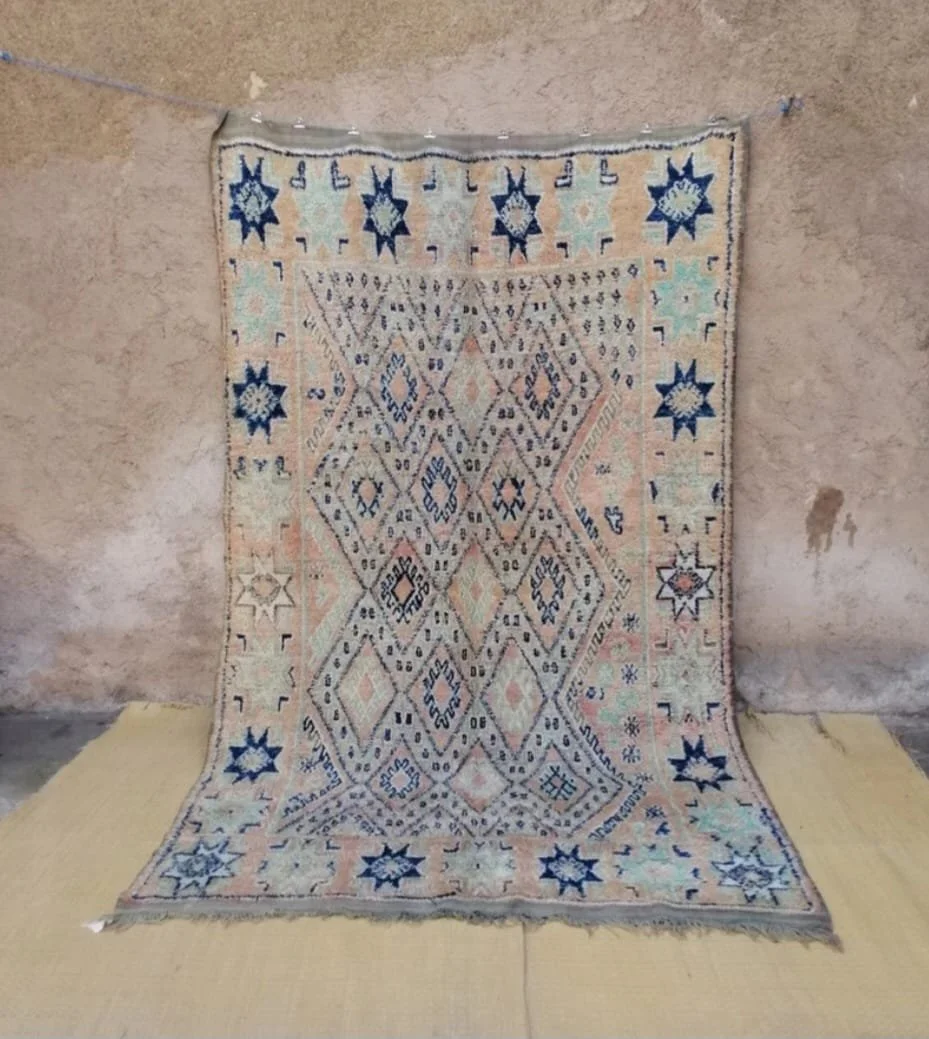
This authentic Amazigh (Indigenous Moroccan) Beni Mguild rug, woven in the Middle Atlas Mountains during the 1970s, is a rare example of transitional highland weaving—where ancestral Amazigh symbolism meets the geometric influence of Islamic design.
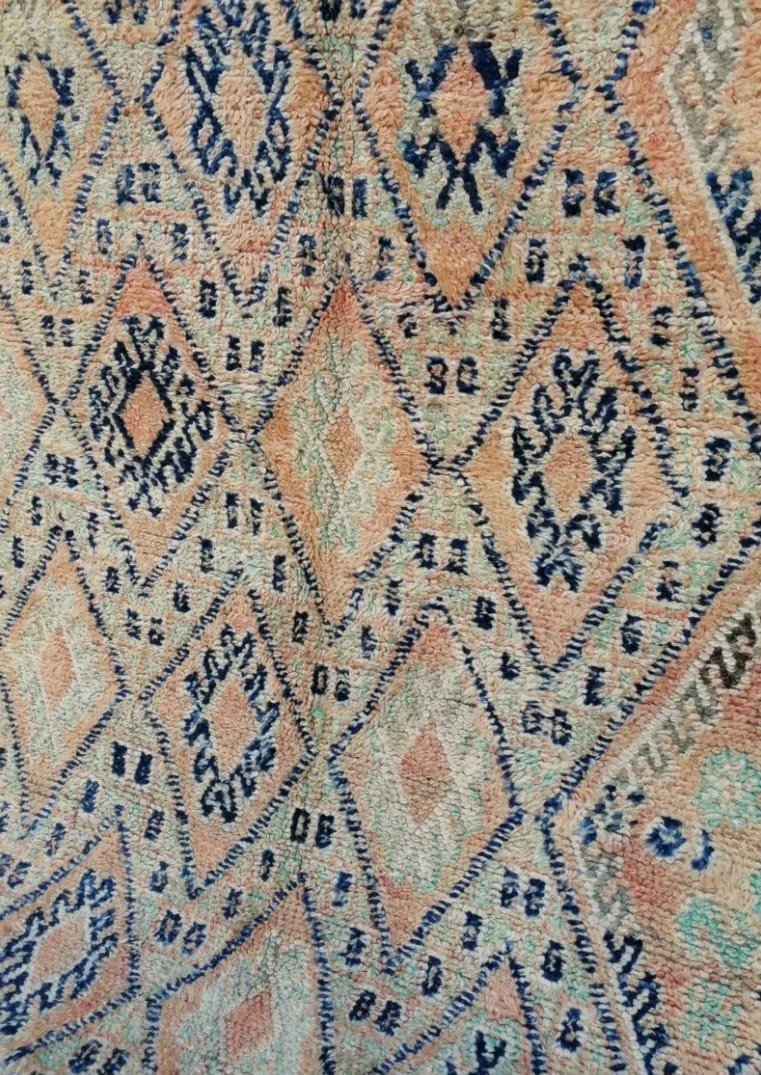
What immediately sets this piece apart is its subtle, sun-faded palette—soft peach, mineral turquoise, aged ivory, and deep indigo—tones that feel almost geological, like pigments weathered into the land itself.
Craftsmanship & Material
100% Atlas sheep wool
Hand-spun, hand-dyed using traditional methods
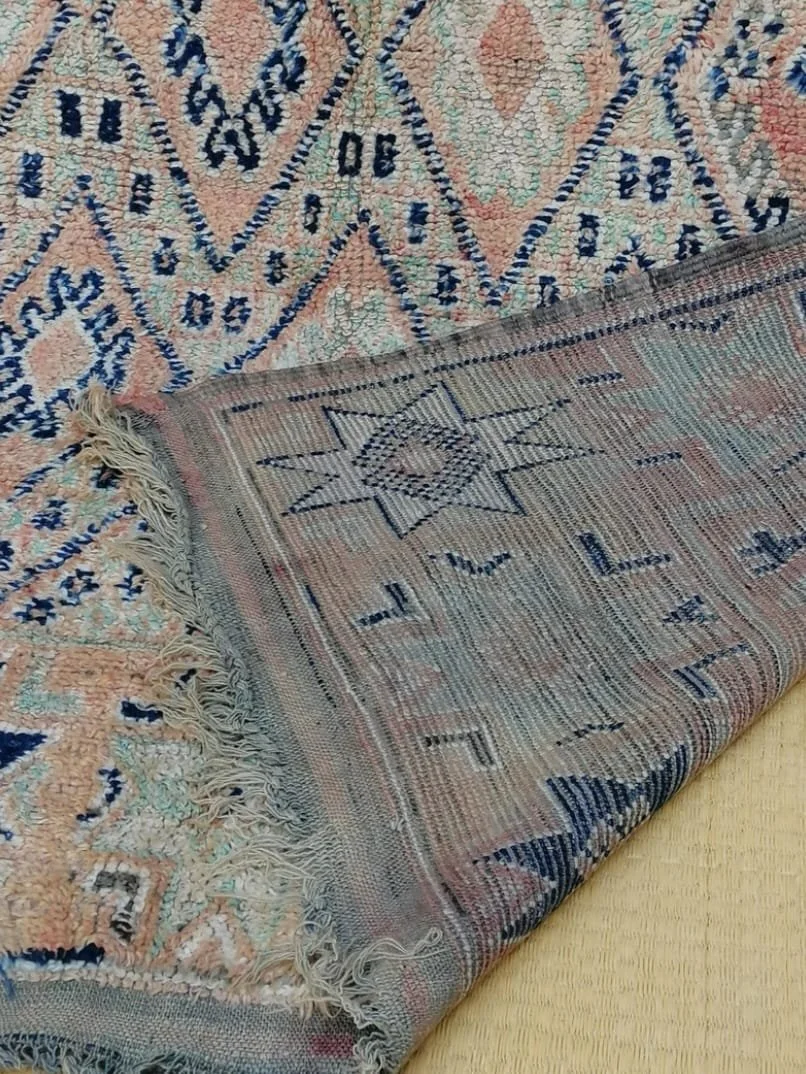
Fully hand-knotted and hand-sheared
Low, vintage pile — soft, supple, and highly durable
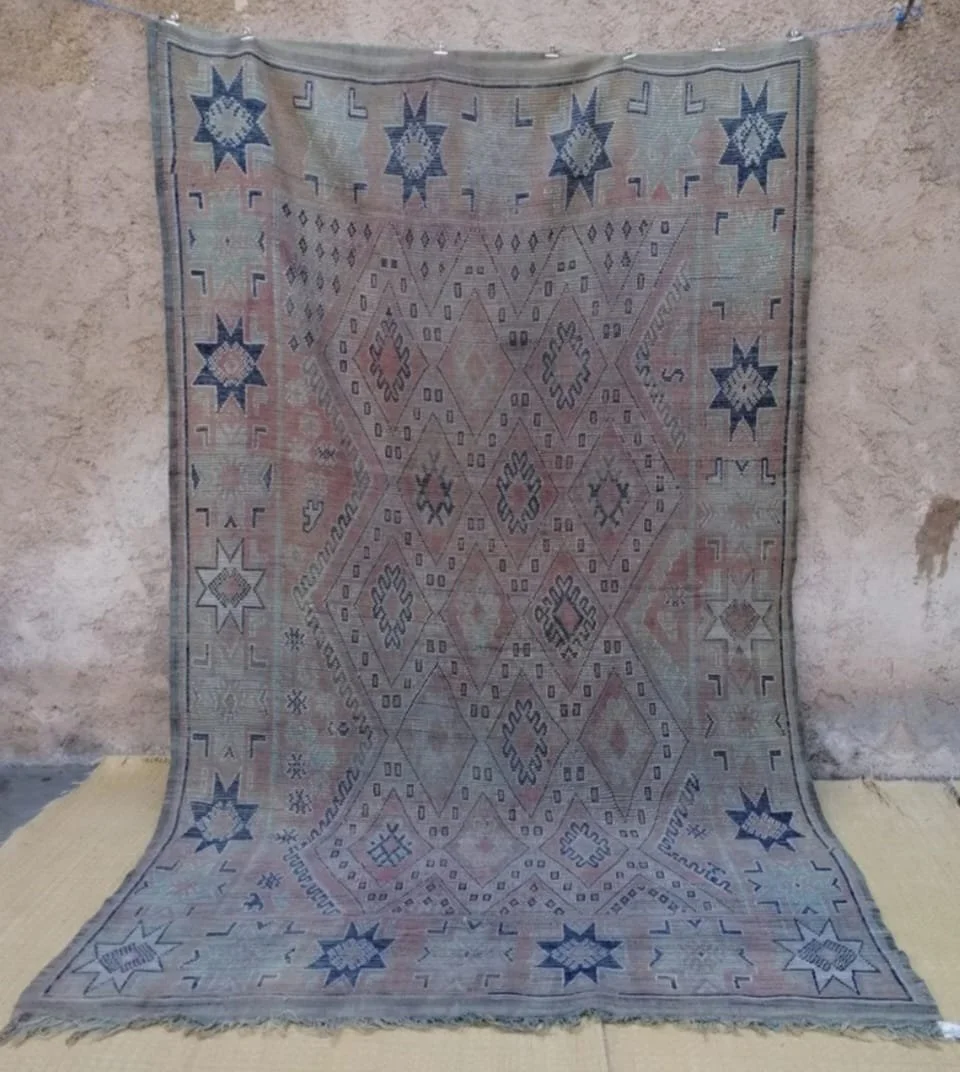
Flexible structure (lays beautifully, not stiff like newer rugs)
This is not production weaving—this is generational knowledge, passed through Amazigh women who wove not for markets, but for their homes, their families, and their stories.
Symbolism & Design Language
At the heart of the rug lies a repeating lozenge (diamond) field, one of the most powerful motifs in Amazigh visual language:
Represents feminine energy, fertility, and protection
Often interpreted as a shield against harm or negative forces
Surrounding this central field are eight-pointed stars, a striking fusion of cultural identities:
Rooted in the Amazigh protective star tradition (originally 4–6 points)
Later expanded into the 8-point “Rub el Hizb”, a sacred geometric symbol in Islamic cosmology
Symbolizes balance, guidance, and the division of the heavens
This rug is a living record of a historical moment—when Amazigh cosmology and Islamic geometry merged into a unified artistic language.
Color & Patina
Unlike modern reproductions, the tones here are naturally aged and harmonized over decades:
Soft peach and clay tones (earth + iron oxide hues)
Faded turquoise and sea-glass greens
Deep indigo accents
Warm ivory base
The result is a quiet, sophisticated palette that integrates effortlessly into modern interiors while retaining deep authenticity.
Dimensions
3.30 m × 2.00 m
10 ft 10 in × 6 ft 7 in
Perfect as a statement piece for:
Living rooms
Bedrooms
Creative or gallery spaces
Condition & Care
Very good vintage condition (1970s)
Clean, structurally sound, no major damage
Minor age-related wear consistent with authenticity
Care:
Cold water wash recommended
Traditional method: snow cleaning (preserves wool oils and softness)
Shipping
Worldwide shipping INCLUDED in price
Professionally packaged and protected
Delivered ready to use
Price
$2,500 USD (shipping included)
Why This Piece Matters
Most rugs on the market today—even those labeled “vintage”—are either:
Over-restored
Chemically washed
Or made for export from the beginning
This piece is different.
It was woven in a time when rugs were still functional art, carrying identity, belief systems, and lived experience. You’re not just buying décor—you’re acquiring a cultural artifact with meaning embedded in every thread.
Handwoven Atlas Mountain Wool | Symbolic Geometric Field | One-of-a-Kind Collector Piece
There are rugs—and then there are pieces that carry landscape, memory, and lineage within every knot.
This authentic Amazigh (Indigenous Moroccan) Beni Mguild rug, woven in the Middle Atlas Mountains during the 1970s, is a rare example of transitional highland weaving—where ancestral Amazigh symbolism meets the geometric influence of Islamic design.
What immediately sets this piece apart is its subtle, sun-faded palette—soft peach, mineral turquoise, aged ivory, and deep indigo—tones that feel almost geological, like pigments weathered into the land itself.
Craftsmanship & Material
100% Atlas sheep wool
Hand-spun, hand-dyed using traditional methods
Fully hand-knotted and hand-sheared
Low, vintage pile — soft, supple, and highly durable
Flexible structure (lays beautifully, not stiff like newer rugs)
This is not production weaving—this is generational knowledge, passed through Amazigh women who wove not for markets, but for their homes, their families, and their stories.
Symbolism & Design Language
At the heart of the rug lies a repeating lozenge (diamond) field, one of the most powerful motifs in Amazigh visual language:
Represents feminine energy, fertility, and protection
Often interpreted as a shield against harm or negative forces
Surrounding this central field are eight-pointed stars, a striking fusion of cultural identities:
Rooted in the Amazigh protective star tradition (originally 4–6 points)
Later expanded into the 8-point “Rub el Hizb”, a sacred geometric symbol in Islamic cosmology
Symbolizes balance, guidance, and the division of the heavens
This rug is a living record of a historical moment—when Amazigh cosmology and Islamic geometry merged into a unified artistic language.
Color & Patina
Unlike modern reproductions, the tones here are naturally aged and harmonized over decades:
Soft peach and clay tones (earth + iron oxide hues)
Faded turquoise and sea-glass greens
Deep indigo accents
Warm ivory base
The result is a quiet, sophisticated palette that integrates effortlessly into modern interiors while retaining deep authenticity.
Dimensions
3.30 m × 2.00 m
10 ft 10 in × 6 ft 7 in
Perfect as a statement piece for:
Living rooms
Bedrooms
Creative or gallery spaces
Condition & Care
Very good vintage condition (1970s)
Clean, structurally sound, no major damage
Minor age-related wear consistent with authenticity
Care:
Cold water wash recommended
Traditional method: snow cleaning (preserves wool oils and softness)
Shipping
Worldwide shipping INCLUDED in price
Professionally packaged and protected
Delivered ready to use
Price
$2,500 USD (shipping included)
Why This Piece Matters
Most rugs on the market today—even those labeled “vintage”—are either:
Over-restored
Chemically washed
Or made for export from the beginning
This piece is different.
It was woven in a time when rugs were still functional art, carrying identity, belief systems, and lived experience. You’re not just buying décor—you’re acquiring a cultural artifact with meaning embedded in every thread.